If you’ve been hearing the term “programmatic advertising” thrown around but aren’t quite sure what it means — you’re not alone. It sounds technical, but the core idea is simple: it’s the automated way that digital ads are bought and sold.
In this guide, I’ll break it all down – what programmatic advertising is, how the technology works behind the scenes, and why it matters whether you’re a publisher, advertiser, or someone just starting out in AdTech.
What Is Programmatic Advertising?
Programmatic advertising is the automated, technology-driven process of buying and selling digital ad inventory in real time, using data and algorithms — instead of human negotiation and manual insertion orders.
Think of it this way: before programmatic existed, an advertiser wanting to run a banner ad on a website would call the publisher’s sales team, negotiate a price, sign a contract, and send over the creative. The whole process could take days or weeks.
With programmatic, that same transaction happens in milliseconds — automatically — the moment a user loads a webpage.
In short: Programmatic = automated ad buying + real-time data + instant auctions.
Why Does Programmatic Advertising Matter?
Programmatic advertising now accounts for the vast majority of all digital display ad spending worldwide. According to industry estimates, over 90% of digital display ads in the US are bought programmatically.
Here’s why it became the dominant model:
- Efficiency: No manual paperwork. Campaigns can be set up, launched, and optimized in hours.
- Precision targeting: Ads reach the right audience at the right moment using data signals like browsing behavior, location, demographics, and more.
- Scale: Advertisers can reach millions of users across thousands of websites from a single platform.
- Transparency: Advertisers can see exactly where their ads ran and how they performed.
For publishers, programmatic opened up access to thousands of advertisers — not just the ones their sales team could call.
How Does Programmatic Advertising Work? (Step-by-Step)
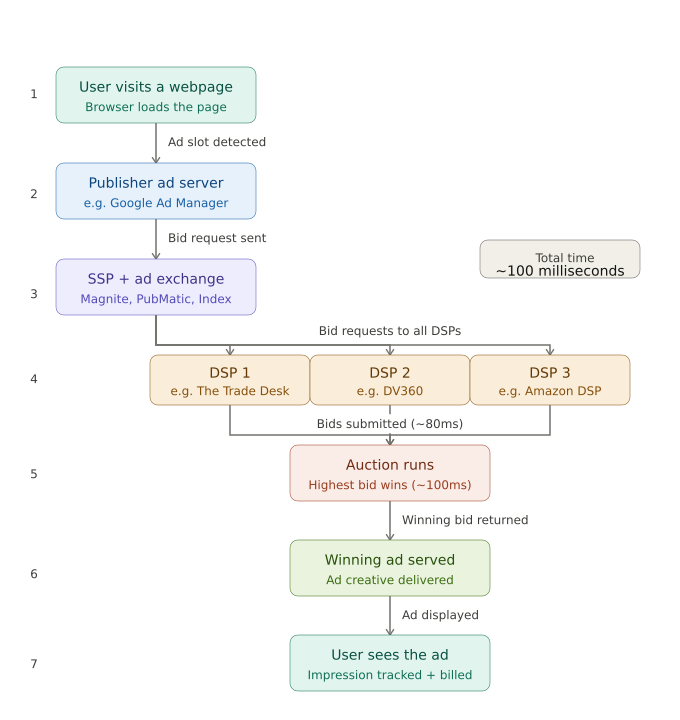
Here’s what happens in the fraction of a second between a user loading a page and an ad appearing on their screen:
Step 1: User visits a webpage
A user navigates to a publisher’s website — say, a news article or a blog post.
Step 2: The publisher sends a bid request
The publisher’s ad server (like Google Ad Manager) detects an available ad slot and sends a bid request to the ad exchange. This request contains anonymized data about the user, the page context, and the ad placement details.
Step 3: Advertisers bid in real time
The ad exchange passes this bid request to multiple Demand-Side Platforms (DSPs) — the platforms advertisers use to buy ads. Each DSP evaluates the impression based on the advertiser’s targeting criteria and, if it matches, submits a bid price.
This entire process is called Real-Time Bidding (RTB), and it happens in roughly 100 milliseconds — faster than the blink of an eye.
Step 4: The highest bid wins
The ad exchange runs an auction and selects the winning bid (typically the highest, though auction mechanics vary). The winning advertiser’s ad is served to the user.
Step 5: The ad is displayed
The user sees the ad. The publisher gets paid. The advertiser gets the impression.
The Key Players in the Programmatic Ecosystem
Understanding programmatic means knowing who the main players are and what role each one plays.
Publishers
Publishers are the owners of websites, apps, or streaming platforms that have ad inventory to sell — ad slots on their pages. They want to maximize revenue from that inventory.
Advertisers
Advertisers are brands or agencies that want to reach specific audiences with their ads. They want to buy impressions efficiently and at the right price.
DSP (Demand-Side Platform)
A DSP is the technology platform advertisers use to buy ad inventory across multiple publishers and ad exchanges. Popular DSPs include The Trade Desk, DV360 (Google’s DSP), and Amazon DSP.
SSP (Supply-Side Platform)
An SSP is the technology platform publishers use to sell their ad inventory programmatically. SSPs connect publishers to multiple ad exchanges and DSPs, helping maximize competition for each impression. Popular SSPs include Google Ad Manager, Magnite, PubMatic, and Index Exchange.
Ad Exchange
An ad exchange is the marketplace where DSPs and SSPs meet to conduct auctions. It’s the infrastructure that facilitates the real-time bidding process.
DMP (Data Management Platform)
A DMP stores and organizes audience data that advertisers and publishers use to improve targeting. With the deprecation of third-party cookies, DMPs are evolving into CDPs (Customer Data Platforms).
Ad Server
An ad server is the technology that delivers the actual ad creative to the user once the auction is won. Publishers use ad servers like Google Ad Manager to manage their inventory and trafficking.
Types of Programmatic Buying
Not all programmatic transactions work the same way. Here are the main buying models:
Open Auction (Open RTB)
The most common form. Publishers make their inventory available to all buyers through an open auction. Anyone can bid. This maximizes competition but gives publishers less control.
Private Marketplace (PMP)
A publisher invites specific advertisers to bid on inventory before it goes to the open auction. This gives publishers more control over who advertises on their site and often results in higher CPMs.
Preferred Deals
A one-on-one deal between a publisher and an advertiser at a fixed CPM. The advertiser gets first look at the inventory, but there’s no guarantee of purchase.
Programmatic Guaranteed (PG)
The closest thing to the old direct sales model. A publisher and advertiser agree on a fixed price and guaranteed volume — but the transaction is executed programmatically, removing the manual paperwork.
Programmatic vs. Direct Ad Sales: What’s the Difference?
| Programmatic | Direct Sales | |
|---|---|---|
| How ads are bought | Automated, via auction or deal | Manual, via negotiation |
| Speed | Milliseconds | Days to weeks |
| Targeting | Data-driven, real-time | Audience-level, pre-defined |
| Flexibility | High | Lower |
| Minimum spend | Often low | Usually high |
| Transparency | High | Varies |
Most large publishers use both — direct sales for premium placements and programmatic to monetize the rest of their inventory.
Programmatic Advertising Channels
Programmatic isn’t limited to display banners. It now powers advertising across multiple channels:
- Display advertising — Banner ads on websites and apps
- Video advertising — Pre-roll, mid-roll, and out-stream video ads
- Mobile in-app advertising — Ads within smartphone and tablet apps
- CTV and OTT advertising — Ads served within streaming video content on smart TVs and connected devices
- Digital Out-of-Home (DOOH) — Digital billboards and signage
- Audio advertising — Ads in podcasts and streaming music platforms
- Native advertising — Ads that match the look and feel of surrounding content
Common Programmatic Advertising Terms You Should Know
CPM (Cost Per Mille): The price per 1,000 ad impressions. The standard metric for display and video advertising.
RTB (Real-Time Bidding): The auction process where ad impressions are bought and sold in real time.
Fill Rate: The percentage of available ad slots that were successfully filled with an ad.
Viewability: A measure of whether an ad had the opportunity to be seen by a user (per IAB standards, at least 50% of pixels in view for at least 1 second for display; 2 seconds for video).
Frequency Cap: A limit on how many times a single user sees a particular ad within a set time period.
Floor Price: The minimum CPM a publisher will accept for their inventory.
IVT (Invalid Traffic): Fraudulent or non-human traffic, including bots, that generates fake impressions.
Brand Safety: Measures that ensure ads don’t appear next to content that could damage an advertiser’s brand reputation.
Programmatic Advertising for Publishers: Key Takeaways
If you’re a publisher trying to monetize your website or app, here’s what programmatic means for you:
- You don’t need a sales team to access thousands of advertisers — your SSP handles that.
- Header bidding lets multiple SSPs compete simultaneously for your inventory, increasing competition and CPMs.
- Your floor price strategy matters — setting floors too high hurts fill rate; too low leaves money on the table.
- Data is your asset — first-party audience data makes your inventory more valuable to advertisers.
- Ad quality matters — monitoring for IVT and brand safety protects your reputation and revenue.
Programmatic Advertising for Advertisers: Key Takeaways
If you’re on the buy side:
- Audience targeting is your superpower — programmatic lets you reach specific people, not just specific pages.
- Choose your DSP wisely — different DSPs have different inventory access and specialty areas.
- Frequency capping is essential — without it, you’ll annoy users and waste budget.
- Viewability and brand safety should be non-negotiable KPIs in your campaigns.
- PMPs offer better quality than open auction, often worth the higher CPMs for brand campaigns.
The Future of Programmatic Advertising
The programmatic ecosystem is in the middle of a major transformation:
The cookieless future: Third-party cookies — long the backbone of programmatic targeting — are being phased out. Google’s Privacy Sandbox, Universal ID solutions like Unified ID 2.0, and first-party data strategies are rising to fill the gap.
CTV is exploding: Connected TV is the fastest-growing channel in programmatic. As more viewers cut the cord, ad spend is following them to streaming platforms.
AI and machine learning: Bidding algorithms are becoming increasingly sophisticated, with DSPs using predictive models to optimize spend in real time.
Supply path optimization (SPO): Advertisers are cutting out redundant intermediaries to reduce costs and improve transparency in the supply chain.
Final Thoughts
Programmatic advertising can seem overwhelming at first glance, but at its core, it’s simply a smarter, faster way to connect advertisers with audiences — at scale.
Whether you’re a publisher looking to maximize revenue, an advertiser trying to reach the right people efficiently, or someone building a career in AdOps, understanding programmatic is the foundation everything else is built on.
In future posts on AdTechGuide, I’ll go deeper on each piece of this ecosystem — from how to set up Google Ad Manager, to header bidding strategies, to CTV advertising mechanics.